
Jan 27-2026
Why Magnesium Supplementation Matters: The Overlooked Mineral Behind Modern Health Challenges
READ MORE >
Zinc is an essential trace mineral. But with so many zinc sources on the market, why does Zinc Picolinate hold a strong position in premium formulations?
The answer isn’t about “zinc” itself — it’s about who can get zinc into the cells.
You may have encountered this situation: customers report “not feeling any effect,” or consumers choose a more expensive brand even though the zinc content is similar.
The culprit is often absorption rate.
Common zinc salts (e.g., zinc oxide, zinc sulfate) dissolve in stomach acid but tend to form insoluble precipitates with phytates and fibers from food, eventually being excreted.
The body requires specific carrier channels to absorb zinc — and picolinic acid acts as that “guide.”
What makes Zinc Picolinate unique: Picolinic acid is a naturally occurring metabolite of the amino acid tryptophan, also found in human breast milk. It forms a stable chelate ring with zinc, helping it bypass absorption barriers and enter intestinal epithelial cells efficiently.
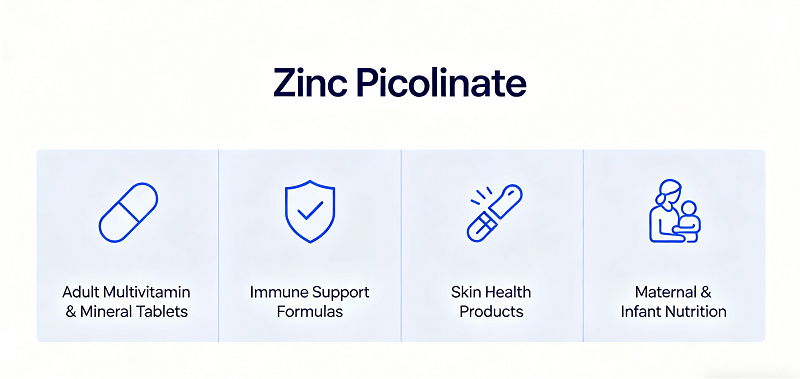
Q1: Which product categories is it suitable for?
Adult multivitamin/mineral tablets – enhances overall product quality perception
Immune support formulations – fast-acting, ideal for consumers seeking noticeable effects
Skin health products (acne, wound healing) – zinc absorption directly impacts real-world outcomes
Maternal & infant nutrition – picolinate structure closely resembles zinc’s natural form in breast milk
Q2: How to evaluate its cost-effectiveness?
Zinc Picolinate has a higher unit price than zinc oxide but lower than certain patented chelated zinc forms. Its cost-effectiveness should be measured from the “effective dose” perspective:
Suppose a formulation needs to deliver the absorption effect of 5 mg elemental zinc
Zinc oxide might require 15 mg, while Zinc Picolinate might need only 6-8 mg
Although the unit cost is higher, lower inclusion rates and more reliable efficacy may result in comparable or even better overall formula cost
For mid-to-premium brands, the “trust factor” and improved repurchase rates brought by Zinc Picolinate are often more important decision drivers.
Q3: Supply stability and quality?
As a specialized nutrient mineral salt manufacturer, we provide:
High purity – Assay ≥98%, precise control of zinc content
Low impurities – Heavy metals (lead, arsenic, cadmium) well below regulatory limits
Batch-to-batch consistency – Retained samples, full traceability
Complete documentation – COA, TDS, MSDS, and third-party test reports
| Feature | Zinc Oxide | Zinc Picolinate |
| Absorption mechanism | Passive diffusion, easily interfered | Active transport, chelate-protected |
| Relative bioavailability | Baseline 1x | Approx. 3-5x |
| GI tolerance | Lower (avoid on empty stomach) | High |
| Best for | Cost-sensitive mass-market products | Efficacy-focused mid-to-premium products |
| Typical dosage | Higher | Lower to achieve same effect |
If you are evaluating zinc ingredient upgrades or want to add a “high-absorption zinc” option to your existing product line, Zinc Picolinate deserves serious consideration.
We provide:
Free samples
Formulation compatibility testing support
Custom packaging options
Contact our sales engineer today for samples, COA, and technical documentation.