


May 16-2026
Zhaoyi Bio Chelated Glycinates: High-Absorption, Manufacturing-Friendly Minerals for Your Formulations
READ MORE >
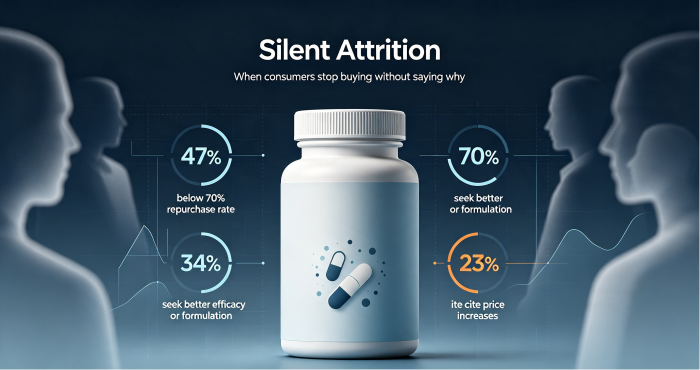
A consumer buys your mineral supplement, takes it for a few weeks, and then stops. No complaints. No refund request. They simply disappear.
This is the silent attrition that haunts the supplement industry — and it is far more common than many brands realize.
Recent market research offers a sobering look at the numbers. In China's vitamin and mineral supplement market, consumers with a repurchase rate above 70% account for approximately 53% of buyers. That means nearly half of all buyers — 47% — have a repurchase rate below 70%.
Among those who switch brands, 34% cite "seeking better efficacy or formulation" as their reason for leaving. Another 23% point to price increases.
The implication is clear: for a significant portion of consumers, the product simply did not deliver a compelling enough experience to justify continued use. They didn't "feel" it working.
This article examines why this happens — and what it means for brands formulating mineral supplements.
Why do so many consumers feel that mineral supplements "don't work"?
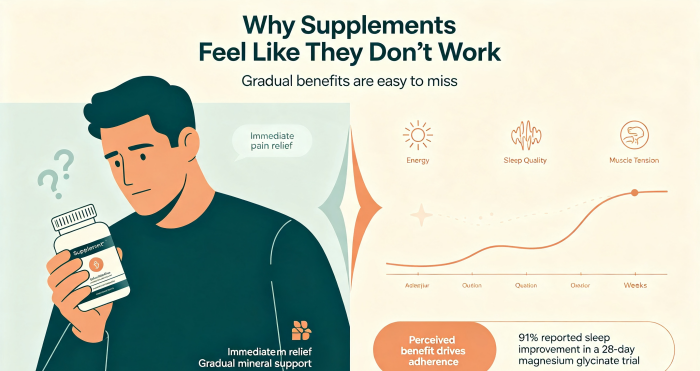
Part of the answer lies in the nature of mineral supplementation itself. Unlike a painkiller that provides immediate relief, minerals work gradually, supporting fundamental physiological processes over time. The benefits are often subtle — improved energy, better sleep, reduced muscle tension — and may take weeks or months to become noticeable.
This creates an expectation-reality gap. Consumers are often told that a supplement will "support health" or "boost energy," but they lack a clear framework for what to expect, when to expect it, and how to measure it.
Research on multivitamin and multimineral (MVM) users has found a striking pattern: MVM users self-report better overall health despite no apparent differences in clinically measurable health outcomes. In other words, those who perceive a benefit are far more likely to continue using the product. Those who do not perceive a benefit — regardless of whether a biological effect is occurring — are the ones who walk away.
A 2026 consumer study on magnesium glycinate illustrates this point well. In a 28-day trial with 95 participants, 91% reported improvement in sleep. The majority of participants reported no side effects and described the product as easy to incorporate into their nightly routine. That is a tangible, perceivable benefit — and it drives adherence.
When consumers cannot perceive a difference, adherence suffers.
This brings us to a critical question: Why do some mineral supplements deliver perceivable benefits while others do not?
The answer often lies not in the mineral itself, but in its form.
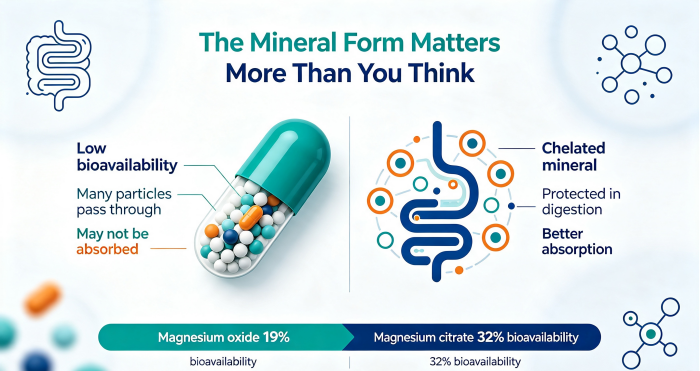
Traditional inorganic mineral salts — magnesium oxide, calcium carbonate, ferrous sulfate — are inexpensive, but they share a common limitation: low bioavailability. A significant portion of the mineral passes through the digestive system without being absorbed. Consumers may be taking the recommended dose, but their bodies are not receiving the expected amount.
Take magnesium oxide as an example. Comparative studies show its solubility is only about 0.37%, with a bioavailability of approximately 19%. In contrast, organic forms like magnesium citrate show solubility of about 85% and bioavailability of approximately 32%. The difference in what actually reaches the body is substantial.
When a consumer takes a low-bioavailability mineral and notices no change in how they feel, the product has failed to meet their expectations. They don't blame the mineral form — they blame the brand.
In contrast, chelated minerals — such as magnesium glycinate, ferrous bisglycinate, and zinc glycinate — are designed for superior absorption. The amino acid "chelates" or surrounds the mineral ion, protecting it from interference in the digestive tract and facilitating active transport across the intestinal wall.
This translates into a better consumer experience. Magnesium bisglycinate, for instance, is known for its high absorption and low gastrointestinal irritation. Users are less likely to experience the digestive discomfort that often accompanies inorganic forms — and more likely to notice the intended benefits.
Consumer research reinforces this. In one study, a milder flavor profile in magnesium bisglycinate formulations was shown to greatly improve user experience and help boost product loyalty through enhanced enjoyment and adherence. When a supplement is easy to take, gentle on the stomach, and delivers perceivable results, consumers stick with it.
Absorption is only half the story. The other half is tolerability.
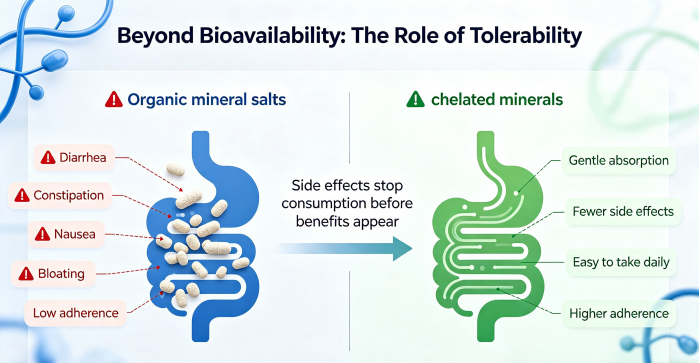
Inorganic mineral salts are notorious for gastrointestinal side effects. Magnesium oxide and sulfate can cause diarrhea. Ferrous sulfate frequently leads to constipation, nausea, and abdominal pain. Calcium carbonate can cause bloating and gas.
These side effects are not merely inconveniences — they are adherence killers. A consumer who experiences digestive discomfort is unlikely to continue taking the product, regardless of its potential long-term benefits.
Chelated minerals offer a clear advantage here. Magnesium glycinate, for example, is "less likely to cause gastrointestinal discomfort or laxative effects" compared to other forms. A 28-day consumer study found that the majority of participants reported no side effects. For consumers, this means a supplement that fits seamlessly into daily life — not one that disrupts it.
This is particularly important for populations that require long-term supplementation. The elderly, individuals with sensitive digestive systems, and those taking multiple supplements are all more likely to discontinue a product that causes discomfort. For brands, choosing a well-tolerated mineral form is not just a formulation decision — it is a retention strategy.
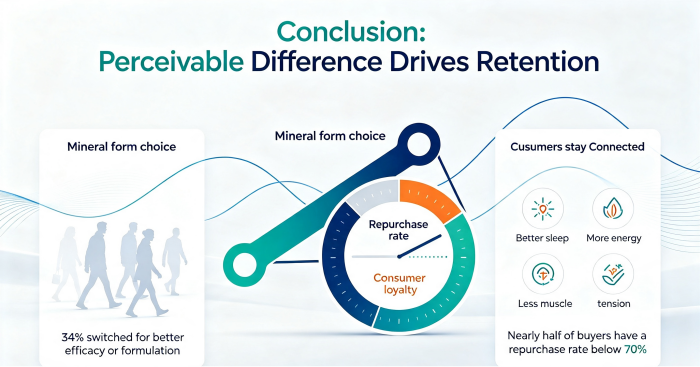
The data on consumer attrition carries a clear message: perceived efficacy drives loyalty.
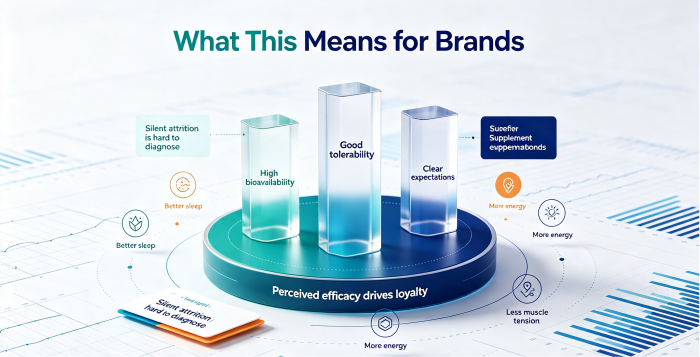
When consumers can feel the difference — better sleep, more energy, less muscle tension — they are far more likely to repurchase. When they cannot, they leave. And they often leave quietly, without complaint, making it difficult for brands to diagnose the problem.
For brands formulating mineral supplements, the path to higher retention lies in three areas:
Choose highly bioavailable mineral forms. Chelated minerals — bisglycinates, citrates, and other organic forms — offer superior absorption compared to inorganic oxides and carbonates. This increases the likelihood that consumers will actually experience the intended benefits.
Prioritize tolerability. Side effects are adherence killers. Mineral forms that are gentle on the digestive system reduce the friction that causes consumers to discontinue use.
Manage consumer expectations. Clear communication about what the product does, how long it takes to work, and what benefits to expect can bridge the expectation-reality gap. When consumers know what to look for, they are more likely to notice the subtle improvements that mineral supplementation provides.
The 34% of consumers who switch brands seeking "better efficacy or formulation" are not just statistics — they are opportunities lost. Each one represents a consumer who tried a product, didn't feel the difference, and moved on.
For brands, the choice of mineral form is not merely a technical formulation decision. It is a strategic lever that directly impacts consumer retention. Highly bioavailable, well-tolerated chelated minerals help ensure that consumers actually experience the benefits they are paying for — and that they keep coming back.
In a market where nearly half of buyers have a repurchase rate below 70%, delivering a perceivable difference is not a nice-to-have. It is a competitive necessity.